Your Design, Someone Else's Factory: The Legal Risks of Making Your Product in India Through a Contract Manufacturer
Making your product in India through a contract manufacturer? A plain-English guide to RBI filings, know-how, tooling, BIS, brand and exit risks.
By Tushar Nair
Tushar Nair is an Advocate practising before the Supreme Court of India and the Delhi High Court.
Here is a simple picture. You designed a product and built a brand around it. Now you want it made in India, but not in your own factory. You hand the drawings, the materials list and the "how we actually do it" knowledge to an Indian company that also makes things for other brands, perhaps your competitors.
What could go wrong? Quite a lot, but almost all of it is foreseeable. A contract is mostly an answer to one question: "What happens if we disagree later?" So imagine the disagreement now, while everyone is friendly, and write down the answer.
To keep things concrete, imagine a hypothetical mid-sized European kitchen-appliance brand, "Brand A". It has a small Indian subsidiary and an Indian contract manufacturer. Here are the questions we hear most.
1. We have an Indian subsidiary. What does the RBI need from us, and why should a CEO care?
India controls cross-border money under the Foreign Exchange Management Act, 1999 (FEMA). Foreign investment in Indian shares is governed by the Foreign Exchange Management (Non-Debt Instruments) Rules, 2019, with reporting on the Reserve Bank of India's online portal, FIRMS.
Three habits matter most.
The share issue. When the parent sends money for shares, the subsidiary must issue them within 60 days. If it can't, it must return the money within the next 15 days. The price cannot be below "fair value", worked out by a chartered accountant, a SEBI-registered merchant banker or a practising cost accountant, using an internationally accepted method.
The report. Within 30 days of issue, file Form FC-GPR on FIRMS. It tells the RBI, "we issued shares to a foreign investor; here are the details."
The annual return. Every company with foreign investment must file the Foreign Liabilities and Assets (FLA) return by 15 July each year.
Why should a CEO care? A late filing does not vanish. You can usually fix it with a "late submission fee", which grows with the amount and the delay, but only for up to three years. After that comes "compounding": formally admitting the breach and paying to settle it.
The real cost is friction later. When you raise money, sell or take dividends out, the other side's lawyers read every filing. A gap means questions, delays and sometimes a price cut. A clean record is boring. Boring is what you want.
2. Our manufacturer also makes for other brands. How do we stop our know-how from wandering?
Start with a distinction that often blurs: owning something is different from being allowed to use it.
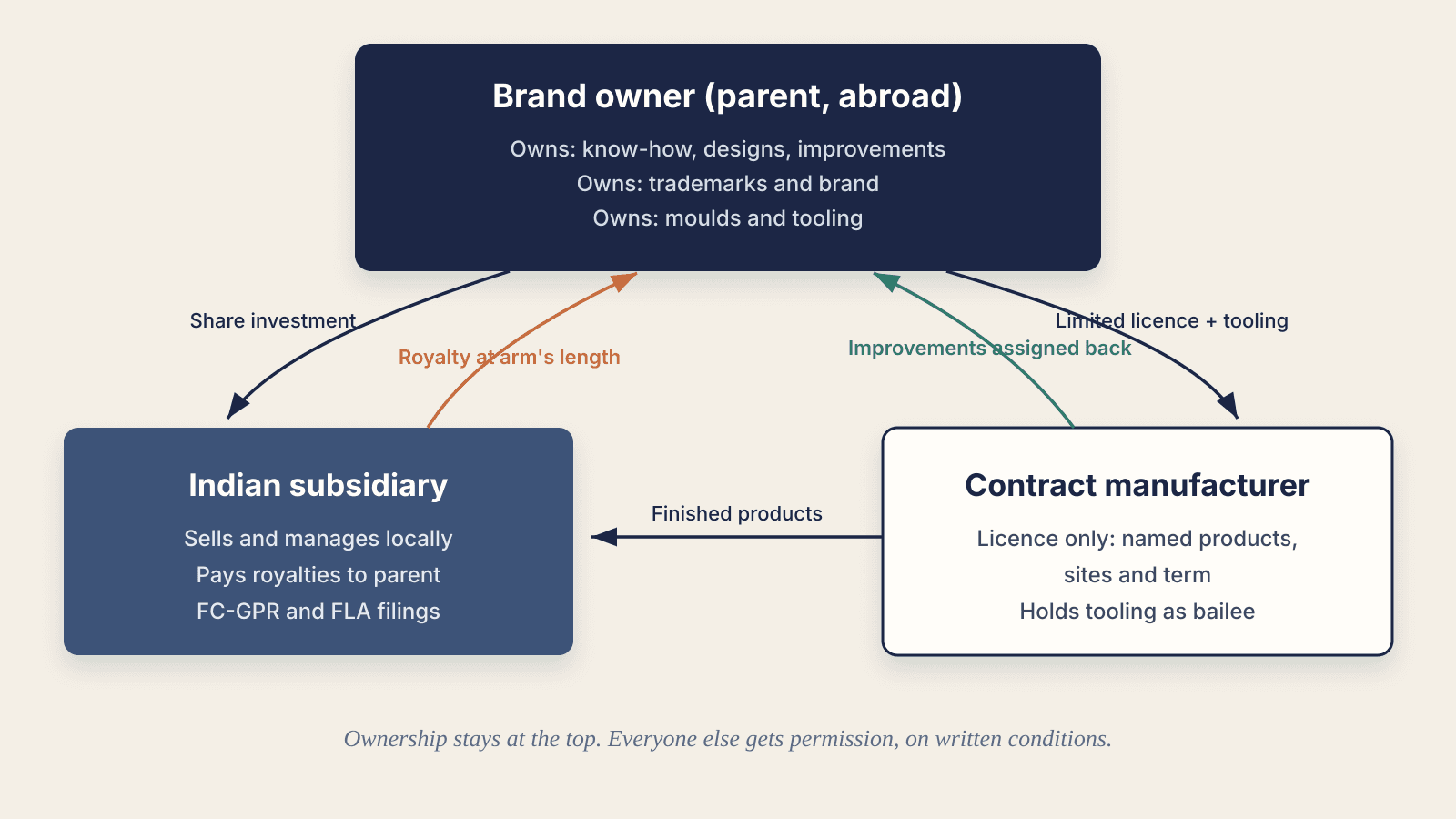
Your know-how stays yours. The manufacturer gets a licence: permission to use it, on conditions. Say so plainly, and list the know-how: drawings, specifications, process settings, test methods, supplier lists, software. If you cannot describe what you are protecting, a court will struggle to protect it.
Make the licence narrow: only your products, only for you, only at named sites, only for the term. Then ring-fence: named people on your products, separate files, controlled access to your data, ideally a separate line, and a right to audit these walls.
Confidentiality must outlive the contract. Make the duty survive termination, and make the manufacturer pass it down to its employees and subcontractors.
India has no standalone trade-secrets statute. Protection comes from the contract and from courts stopping a "breach of confidence". So the contract, and evidence that you really kept things secret, matter more, not less.
3. If engineers in India improve our design, who owns the improvement?
Picture this. Brand A's manufacturer finds a cheaper way to fix a motor bracket, saving a rupee a unit over a million units. Who owns that idea? If the contract is silent, "it depends". So decide in advance: improvements to your products and processes, made in performing the contract, belong to you. The manufacturer must tell you promptly and sign whatever is needed to transfer them.
Two Indian details matter. First, there is no automatic rule that an employer owns its employees' patentable inventions, so write down the chain of assignment, from engineer to manufacturer to you. Copyright differs: under the Copyright Act, 1957, works made by an employee in the course of employment generally belong to the employer, unless agreed otherwise.
Second, under section 39 of the Patents Act, 1970, a person resident in India cannot file a patent application abroad without first filing in India (and waiting six weeks with no secrecy direction) or getting the Patent Office's written permission. If an Indian engineer co-invents and you file only in Europe, you have a real problem. Plan the filing route early.
4. We paid for the moulds. Can we get them back?
Moulds, dies and test fixtures are often the costliest, least visible part of the deal, and easy to hold hostage.
Leaving your property with someone for a purpose is a "bailment" (sections 148 onwards of the Indian Contract Act, 1872). The holder is the "bailee". Under section 170, a bailee who has done work on goods can, in some cases, keep them until paid. That is a lien. The Act lets the parties agree otherwise, and you should.
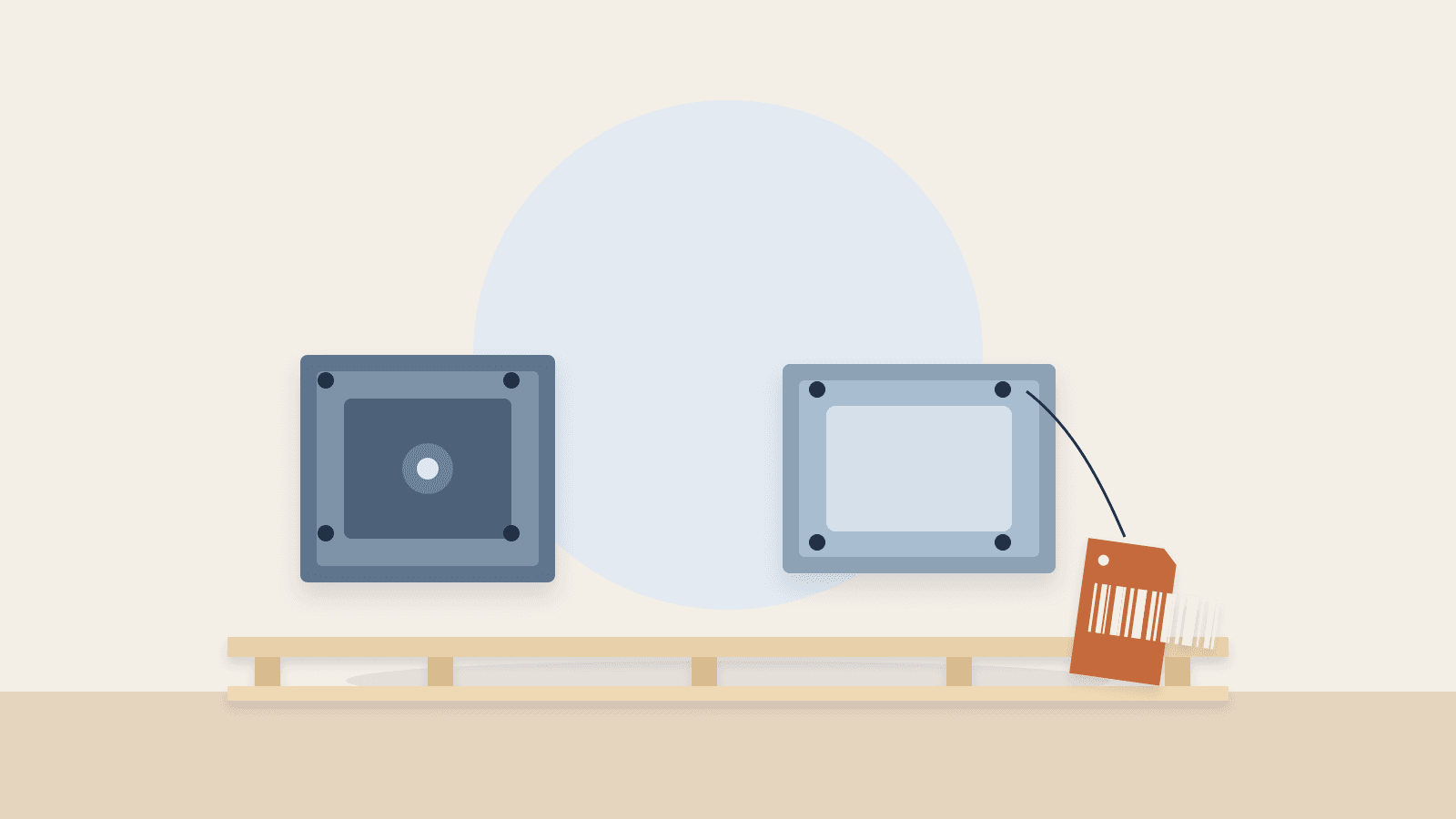
A good tooling clause lists each tool you own, with asset tags. It fixes where tools are kept and bars moving them or using them for anyone else without consent. It makes the manufacturer insure and maintain them. It waives any lien. And it says how you get them back: notice, timing, packing and transport costs. If tools were imported, check customs and tax paperwork too.
5. Will an exclusivity or non-compete clause hold up in India?
Here Indian law is unusual, so slow down. Section 27 of the Indian Contract Act says an agreement restraining anyone from carrying on a lawful profession, trade or business is void to that extent. Its only exception is for someone who sells the goodwill of a business. Unlike English law, Indian law does not save a restraint just because it is "reasonable".
The Supreme Court has drawn a practical line between restrictions during the contract and restrictions after it ends. In Niranjan Shankar Golikari v. Century Spinning and Manufacturing Co. (1967), it upheld a promise not to work for others during the term of service. In Percept D'Mark (India) Pvt. Ltd. v. Zaheer Khan (2006), it held a restraint operating after the contract ended void under section 27.
For Brand A, a promise not to make competing products with your tooling or know-how during the contract has a much better chance than a promise never to compete afterwards. After the end, rely on what the law protects: confidentiality, ownership of your IP and tooling, and your trademarks. Draft exclusivity narrowly, by product and period, and tie it to something you give in return, such as minimum volumes.
6. Does our product need BIS certification, and whose job is it?
The Bureau of Indian Standards (BIS) runs India's product standards. For many products, the government issues "Quality Control Orders" (QCOs) that make certification compulsory. A covered product cannot lawfully be made, sold or imported without the right certification and mark.
There are two broad routes: a licence to use the "ISI mark", or, for many electronics and IT products, the Compulsory Registration Scheme, where a BIS-recognised lab tests the product before registration.
The key fact: certification attaches to a manufacturer at a specific factory, for a specific product and brand. If your contract manufacturer makes your product, the registration or licence is usually tied to its factory, with your brand authorised on it. Move production, and you may need a new one: certification does not travel with you. So the contract should say who applies, who pays for testing, who keeps it valid and who handles labels.
The list changes. In November 2025, for example, the government withdrew a batch of QCOs, mostly on chemicals, polymers and metals. Check today's position for your product and components, and neighbouring rules, such as producer responsibility under the E-Waste (Management) Rules, 2022, which can fall on the brand owner.
7. How do we protect our brand from look-alikes?
A trademark tells customers who stands behind a product. In India, the Trade Marks Act, 1999 governs. A registration lasts ten years and can be renewed. Four layers work together.
File early. Register the name, logo and key product names in every class you need (classes are the categories registries sort goods and services into). India recognises rights from prior use, but a registration is far easier to enforce.
Watch. A watch service flags look-alike applications so you can oppose them before registration.
Record with customs. Under the Intellectual Property Rights (Imported Goods) Enforcement Rules, 2007, you can record your registered trademark with Indian Customs online. Customs can then suspend clearance of suspected fakes. A recordal lasts up to five years, or until the registration expires if sooner. These rules cover imports.
Clean up marketplaces. Online platforms have takedown processes and duties under the Information Technology Act, 2000 and its rules. Keep evidence, use them, and go to court when needed.
And in the contract: the manufacturer gets no rights in your brand, and must return or destroy branded packaging and rejects. Factory "overruns" sold out the back door are a classic source of fakes.

8. We want to export from India. What has to line up?
Export often gets planned after the manufacturing contract is signed. That is backwards. Ask early: who is the exporter on the shipping papers? The manufacturer, your subsidiary, or your parent buying from the factory? That decides who needs an Importer-Exporter Code (the basic registration with the Directorate General of Foreign Trade), who gets export benefits, and who carries customs and product-liability risk.
Then make the contract match. A licence to make goods "for sale in India" does not cover exports. Check whether anything is on India's controlled dual-use list (SCOMET). And write the destination market's safety and labelling standards into the specification, because the factory has to build to them.
9. We charge royalties or licence fees. Where does transfer pricing come in?
When your subsidiary pays your parent, two laws look at the payment. Under FEMA, royalties for technology and brand use are current-account transactions. In plain words, they generally don't need RBI approval, though the bank will want paperwork and tax must be withheld.
Tax law is stricter. "Transfer pricing" means payments between related companies must be at an "arm's length price", the price unrelated parties would agree. From 1 April 2026, these rules sit in the Income-tax Act, 2025 (sections 161 to 173, replacing the old sections 92 to 92F). The substance is largely the same.
The practical point is consistency. The licence, the transfer-pricing study and reality must tell the same story. If the agreement says the subsidiary only distributes, but it actually runs product development with the manufacturer, the tax authority may see value created in India that the royalty ignores. Lawyers and tax advisers should read each other's drafts.
10. Where should disputes go, and can we still get urgent help in India?
Most foreign brands prefer arbitration, a private trial before chosen arbitrators, seated somewhere neutral such as Singapore or London. The "seat" is the arbitration's legal home; its courts supervise it.
But the manufacturer, tooling and stock are in India. If something goes wrong on Monday, you may need an order by Wednesday.
The Arbitration and Conciliation Act, 1996 helps. Since the 2015 amendments, the proviso to section 2(2) lets Indian courts grant interim relief under section 9 even for arbitrations seated outside India, unless the parties agree otherwise. That relief can include preserving goods, securing amounts in dispute and injunctions. Two cautions: don't exclude section 9 by accident, and if you get an order before the arbitration starts, start it within 90 days.
Also think about enforcement. India enforces New York Convention awards only from countries the government has notified as "reciprocating". Most major seats are listed. Check yours.
And the exit: how do we leave without being held up?
Every manufacturing relationship ends, like a handover or like a hostage negotiation. Write the exit with the entry: a transition period in which the manufacturer keeps producing while you move; return of tooling, drawings, data, branded materials and unused components, on a timetable; a written certificate that confidential material was returned or destroyed; a rule on who pays for work in progress; help transferring certifications and supplier relationships where possible; and confidentiality, IP and tooling clauses that survive termination.
A simple test on signing day: "If we had to move production in 90 days, what would we need from them, and does the contract make them give it?"
A closing thought
None of this is exotic. It is writing down, in advance, who owns what, who does what and what happens at the end. Doing it now costs a few careful conversations. Not doing it means learning the answers in court.
Nair & Co advises foreign companies on these issues, including FEMA compliance, manufacturing and licensing agreements, trademarks, and arbitration. If any of this raises questions for your India plans, we are happy to talk.
This article is general information, not legal advice. Please take specific advice before acting on it.