The Incentive Is the Easy Part: What Foreign Manufacturers Risk When They Build in India on a Government Scheme
Building in India on ECMS or PLI incentives? Plain-English guide to clawback, claim files, IP, power, approvals, DPDP and disputes.
By Tushar Nair
Tushar Nair is an Advocate practising before the Supreme Court of India and the Delhi High Court.

Getting approved under an Indian incentive scheme feels like the finish line. It is closer to the starting gun.
An approval letter is a government promise: invest, produce, sell and hire as agreed, and we will pay you. The money comes later, in instalments, after you prove your part. Anything that could stop you proving it, or let the government ask for the money back, is a legal risk.
To keep this concrete, imagine a hypothetical European maker of multilayer circuit boards, "Company B". It sets up an Indian subsidiary, gets approval under a government scheme, and brings in an Asian technology partner for one process. Three parties, one factory. Here are the questions worth asking.
1. How do schemes like ECMS and PLI actually work, and what are we promising?
PLI stands for "Production Linked Incentive". The government pays a percentage of your extra sales of India-made products, over a base year, if you also meet investment thresholds.
The Electronics Component Manufacturing Scheme (ECMS), notified on 8 April 2025 with operating guidelines from 26 April 2025, applies similar logic to components. Depending on the product, it offers a turnover-linked incentive (a percentage of extra sales), a capex incentive (a percentage of eligible capital spending), or a mix. The outlay was originally ₹22,919 crore; the government says the Union Budget 2026-27 raised it to ₹40,000 crore.
Notice what you are promising under the ECMS guidelines:
- Investment must hit yearly thresholds. Land and buildings don't count. Plant, machinery, tools, moulds, utilities and in-house R&D capital spending can.
- Sales are "net" sales, after discounts, credit notes, taxes, advertising and brand royalty.
- Employment matters. Part of the incentive is paid only if you meet hiring thresholds, counted from Employees' Provident Fund records. Apprentices and casual workers don't count.
- You must make it yourself. Manufacturing through a contract manufacturer is not eligible, though limited job work is allowed.
That last point surprises people. If you planned to outsource production, the scheme may not fit.
2. What can make the government take the money back?
"Clawback" means the government recovering an incentive already paid, often with interest. The triggers fall into three groups.
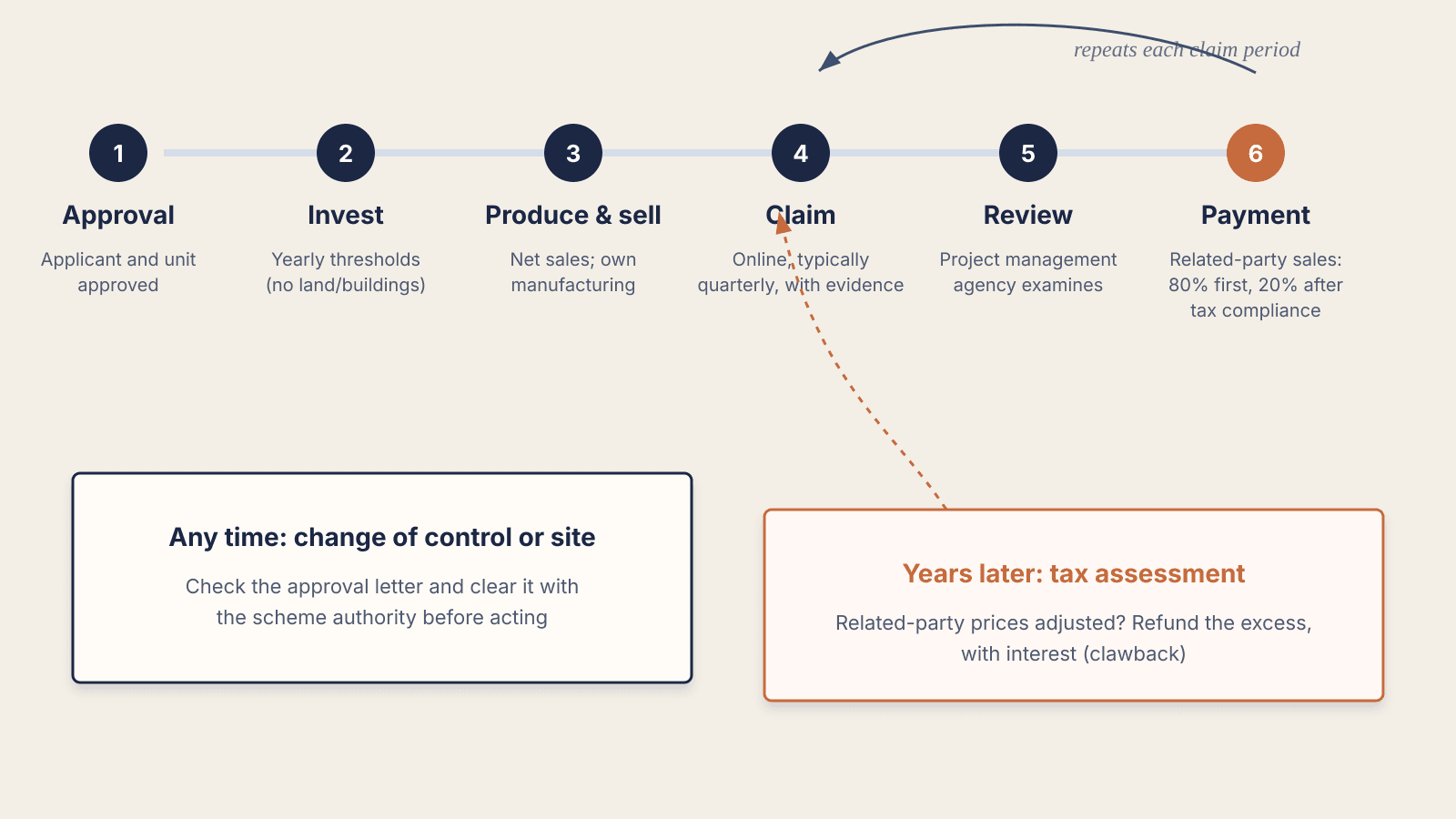
You didn't do what you promised. Under ECMS, if an applicant makes no investment in the first year, or falls below half the threshold investment later, the approval may be revoked. A substantial sales shortfall can do the same. You get a chance to explain first.
The numbers change later. ECMS requires an undertaking that if a tax assessment later adjusts your related-party prices in a way that affects the incentive, you will refund the excess, with interest at the three-year SBI lending rate, compounded annually. Assessments often come years later, so a transfer-pricing dispute in year five can reopen a claim from year one.
The company changes. Founders overlook this. A funding round, merger, share sale, group restructuring or move to another site can all matter. Incentives attach to an approved applicant and an approved project or unit. Earlier scheme guidelines, such as MeitY's PLI guidelines, require a change in ownership to be reported and approved before the new owner can claim. Read your own approval letter and guidelines for the exact rule, and clear any change of control or location with the scheme authority before you do it.
A good habit: before any share issue, restructuring or site change, the board asks, "Does this touch our approval?"
3. How do we build a claim file that survives an audit?
Treat a claim like a scientific claim: not just saying something happened, but showing evidence a sceptical stranger can check.
ECMS claims are filed online, typically quarterly once thresholds are met, and examined by a project management agency for the ministry. So build the file from day one of production, not deadline week.
Contents: invoices for all capital spending, matched to the asset register. Proof that machines were installed and used for the approved product. Sales invoices tied to dispatch and booked revenue. Monthly employment data matching provident fund records. Related-party transactions backed by a transfer-pricing report. And if the plant makes approved and non-approved products, a consistent method of splitting sales, investment and staff between them, which the guidelines expect to stay the same for the whole scheme period.
One useful detail: for related-party sales, ECMS releases 80% of the incentive first and the remaining 20% only after tax compliance is done. Plan cash flow accordingly.
4. Who owns the IP when the parent, the Indian company and a technology partner all touch it?
Intellectual property (IP) means legal rights in ideas: patents for inventions, copyright for code and drawings, designs for shapes, trade secrets for know-how.
With three parties, default rules give unpredictable answers. So draw a three-column map: what each party brought in (background IP), what gets created during the project (foreground IP), and who may use what, for what purpose.
For Company B, a clean map might say: the parent owns its core designs; the partner owns its process; the Indian company licenses both, for the approved products only; and new IP is allocated by subject, process improvements one way, product improvements another. Write down how "who invented this" disputes get resolved.
Remember section 39 of the Patents Act, 1970. A person resident in India cannot file a patent application abroad without first filing in India and waiting six weeks (with no secrecy direction), or getting the Patent Office's written permission. If Indian engineers are co-inventors, plan the filing route before anyone files in Europe.
5. How should the Indian company license technology from the parent without creating problems?
Two laws look at the same licence. Under foreign exchange law (FEMA), royalties are current-account transactions, which generally means no RBI approval, subject to bank paperwork and withholding tax.
Tax law looks at the price. Payments between group companies must be at an "arm's length price", what unrelated parties would agree. From 1 April 2026, the transfer-pricing rules sit in sections 161 to 173 of the Income-tax Act, 2025, replacing sections 92 to 92F of the 1961 Act. The substance is largely unchanged.
There is also an ownership trap. If the licence says the parent owns everything, but Indian engineers do most of the development, a tax authority may say real value is created in India. Then the royalty, and possibly the parent's profit, look wrong. The fix is not clever drafting; it is agreements that describe reality, and records that prove it.
And remember the scheme. Under ECMS, royalty and technology-transfer payments can count towards investment thresholds but are not themselves incentivised. Brand royalty is also deducted when working out net sales. So one licence fee touches your tax, your investment threshold and your incentive. One spreadsheet should show all three.
6. How do we protect trade secrets when engineers leave?
India has no standalone trade-secrets law. Protection rests on contracts and on the courts' power to stop a "breach of confidence": misusing information shared in trust.
A court will ask: was this really secret, and did you treat it as secret? Evidence matters as much as the clause. Do the basics: need-to-know access, labelled confidential documents, logs of who opened what, exit interviews, collected devices, and a written reminder to departing staff of their duties.
Indian contract law has a hard edge. Section 27 of the Indian Contract Act, 1872 makes agreements restraining a person from carrying on a lawful trade or profession void, and the Supreme Court has held that restraints running after a contract ends are void under it (Percept D'Mark (India) Pvt. Ltd. v. Zaheer Khan, 2006). So a post-employment non-compete is weak protection. Confidentiality obligations, IP assignment clauses and in-term restrictions stand on much firmer ground. Make every engineering contract assign inventions to the employer: India has no automatic rule that the employer owns an employee's patentable invention.
7. What approvals sit on the critical path to production?
A factory is a legal object before it is a physical one. Approvals usually run in sequence, and the slowest sets the date.
Start with land. If a state industrial development corporation allots it, the terms often require construction within a set time and limit transfers, sometimes including changes in the allottee's control. That links back to question 2.
Then come building plan approval and a fire no-objection certificate under state law. Then environmental consents from the State Pollution Control Board: "consent to establish" before you build and "consent to operate" before you run, under the Water Act, 1974 and the Air Act, 1981. Some activities need prior environmental clearance. Factory registration and licensing now fall under the Occupational Safety, Health and Working Conditions Code, 2020, which, with the other three labour codes, came into force on 21 November 2025, replacing the Factories Act, 1948. State rules under the codes are still settling, so check your state.
The practical tool is a tracker: every approval, its authority, documents, expected time and dependencies, matched against the scheme's investment and production milestones.

8. Why is electricity a legal question?
Because in India electricity is not just bought. It is regulated, state by state, under the Electricity Act, 2003.
Connection. You agree a "contracted load" (or contract demand) with the distribution company: the maximum power you may draw. Too low, and you pay penalties or wait for upgrades. Too high, and you pay fixed charges for unused capacity.
Tariff category. Industrial, high-tension and special categories carry different rates and conditions. Check yours.
Open access. Buying power from someone other than your local distribution company, using and paying for its wires. The Green Energy Open Access Rules, 2022 lower the entry point for renewable power to 100 kW, and later amendments allow some connections to be combined to reach it.
Captive power. A plant you partly own, supplying yourself. Under rule 3 of the Electricity Rules, 2005, as substituted in March 2026, a plant is captive only if captive users hold at least 26% of the ownership and consume at least 51% of its output in the year. Get it wrong and the power becomes ordinary supply, with surcharges. The 2026 rules also treat a company's holding and subsidiary companies as one captive user, which helps group structures.
Backup. Diesel generators need permissions and must meet emission norms. Your supply contract should cover outages. For sensitive processes, power quality can matter as much as price.
9. What does the DPDP Act mean for sending employee and customer data to our European companies?
The Digital Personal Data Protection Act, 2023 (DPDP Act) is India's main data protection law. The DPDP Rules, 2025 were notified on 13 November 2025. Most substantive duties come into force 18 months later, in May 2027.
A "data fiduciary" decides why and how personal data is processed, much like a "controller" under European law. You need either consent or a "legitimate use" recognised by the Act. Employment purposes are one such use, which helps with HR data. You must keep reasonable security safeguards, report breaches, and erase data once its purpose is served. Penalties run up to ₹250 crore for failing to keep reasonable security safeguards.
On transfers abroad, section 16 takes a "negative list" approach: transfers are allowed except to countries the government notifies as restricted. As of this writing, none has been notified. Rule 15 adds that you must follow any government orders about making data available to foreign states.
So for Company B: map which Indian data goes to European group companies, and why, and put intra-group data agreements in place. The European side will apply the GDPR, Europe's data law, to the same data. One contract can often serve both.
10. How do we make arbitration clauses work across group, partner and customer contracts?
Arbitration is a private trial before arbitrators you choose. The "seat" is its legal home and decides which country's courts supervise it.
The common mistake is not one bad clause but many different ones. The licence says Singapore, the partner agreement says London, the supply contract says Indian courts. When a dispute touches all three, as it usually does, you get parallel proceedings and inconsistent results.
So pick one family of clauses: the same institution, the same seat, compatible rules, and a clause allowing related disputes to be joined.
Then keep India in reach. Since the 2015 amendments, the proviso to section 2(2) of the Arbitration and Conciliation Act, 1996 lets Indian courts grant interim relief under section 9, such as injunctions or orders preserving assets, even for arbitrations seated abroad, unless the parties agree otherwise. Don't exclude it by accident. If you get an order before arbitration begins, start the arbitration within 90 days.
A closing thought
The incentive is a contract with the state, sitting on top of contracts with your parent, your partner, your landlord, your power supplier and your staff. Each one is manageable. The risk is in the gaps between them. Line them up, keep the evidence, and the incentive becomes what it was meant to be: money you earned.
Nair & Co advises foreign manufacturers on these issues, including scheme compliance, FEMA, IP and licensing, electricity law, data protection and arbitration. If any of this is relevant to your plans in India, we are glad to discuss it.
This article is general information, not legal advice. Please take specific advice before acting on it.